
Let's start with the honest part
Long distance relationships kill desire faster than silence does. You're exhausted from the timezone math, your partner's life is happening without you in the frame, and by the time you sync up for a video call, the mood has evaporated. Enter clitoral vibrators. Not as a replacement for closeness, but as a real tool for maintaining the nervous system connection that keeps intimacy alive when you can't touch.
Why long distance changes sexual dynamics
Distance scrambles three things simultaneously: timing, privacy, and anticipation. When you're in the same city, desire builds naturally. You see your partner, smell them, have spontaneous moments of connection. Long distance erases all of that. You're scheduling sex like a dentist appointment.
Then there's the logistical gap. You might want connection at 10 p.m. on a Tuesday. Your partner is at work. Or it's 3 a.m. for them. The synchronization problem is real, and it's not about willpower. It's about biology meeting time zones.
Clitoral vibrators, particularly lemon vibrators, solve for a specific problem: they let you maintain solo pleasure in a way that feels partnered. You can be on a video call. You can text. You can have rhythms that aren't perfectly aligned but are still interlocked.
The pleasure synchronization problem
Here's what I see most often in long distance couples: one person maintains their pleasure routine, the other stops. The person who stops typically says "it feels lonely" or "it doesn't feel the same without them." Both are valid. Both are also solving the problem backward.
When one person stays connected to their body and the other disconnects, you create a desire gap. The person with solo pleasure maintains their arousal capacity, their neural pathways for orgasm, their sense of entitlement to good sensation. The person who stops gradually loses all three. By the time you're together again, the mismatch is enormous.
Lemon vibrators change this math. Using them while your partner is present (even through a screen) reminds your nervous system that this is a shared experience. It's not about replacing them. It's about staying in conversation with your own body while also staying in conversation with theirs.
How to build a rhythm that actually works
Three things matter here:
Timing that respects both schedules. Find one 20-minute window per week where you're both available and reasonably private. Not every day. Once weekly. That consistency matters more than frequency. Your nervous system recognizes the pattern and starts preparing for it. Anticipation builds.
Permission to be solo within it. You don't both have to climax at the same moment. You don't both have to use a vibrator. The frame is "we're in this together," but the experience can be radically different. One person might be on video call with a Lemon clitoral vibrator. The other might be sending texts. The architecture is "we're connected." The details flex.
A rhythm that builds, not flattens. The mistake most people make is diving straight into intensity. You want to build toward that. Start with conversation or sexting. Move to phone or video. Then bring in touch or vibration. The first week you might just talk. The second week you might send photos. The third week you might use a vibrator while on the call. This isn't teasing or withholding. It's remembering that arousal is a process.
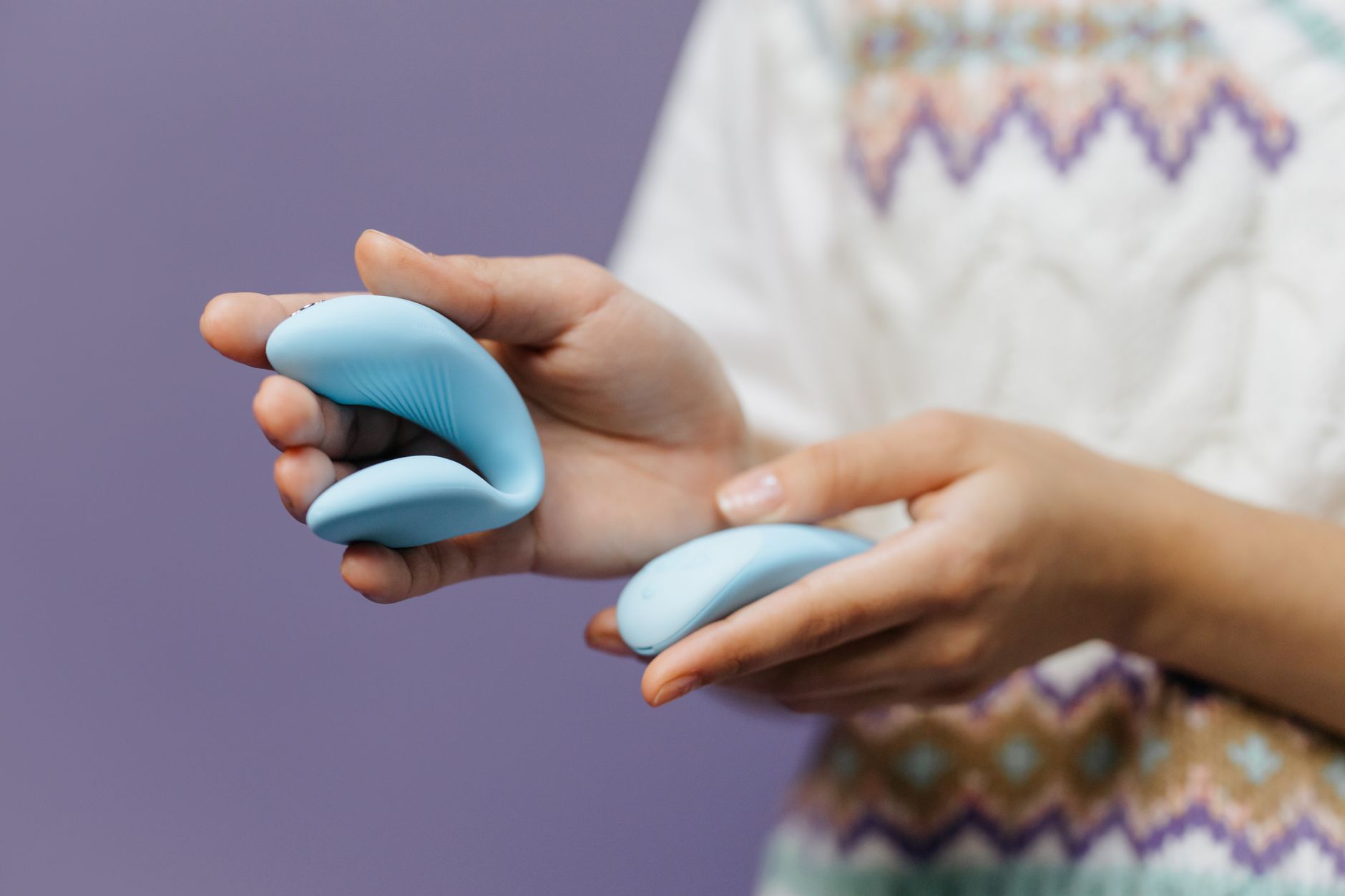
Photo by cottonbro studio on Pexels
The practical setup that actually works
Let's talk logistics, because they matter. You need privacy. You need battery life. You need to not be worried about interruption.
For privacy: lock your door. Tell your roommate you're on an important call. If you live with family, take a walk or use headphones that signal "don't bother me." Privacy isn't about shame. It's about the nervous system settling down enough to actually feel.
For battery: charge your lemon vibrator the morning of your planned time. Most clitoral vibrators last 60 to 90 minutes on a full charge. That's more than enough for a 20-minute connection. If battery anxiety is real for you, keep it plugged in near where you're sitting.
For interruption: put your phone on do-not-disturb except for your partner. Set a timer if you're worried about going long (you probably won't). Tell people in your space that you're unavailable for that window.
The actual texture of the experience: comfortable place to sit, water nearby, phone propped so you can see your partner if you're video calling. Lemon vibrators work best at low to medium settings when you're first building sensation. You have time. There's no rush.
Managing the desire gap
One of you probably wants connection more than the other right now. This is normal. It's also one of the fastest ways long distance relationships tank if you don't address it directly.
If you're the one wanting more: don't weaponize it. Don't frame solo pleasure as "proof" your partner doesn't care. That's not what this is. What it is: an invitation. "I miss you. I want to stay connected. Would you be willing to try this once a week?" That's a conversation, not a demand.
If you're the one who wants less: tell the truth. "I feel weird about this because..." and finish the sentence honestly. Are you not in the mood for the long distance season? Do you have privacy issues? Are you touched out from work? Are you grieving the relationship as it was? All of these change the strategy. A Lemon clitoral vibrator won't fix a deeper disconnect. But it can be a bridge while you figure out what's actually happening.
When to use a vibrator during calls
Here's the rule I give couples: if you're using a vibrator, your partner should know it. Not as performance. Not as spectacle. Just as information. "I'm going to use my vibrator while we talk" is a simple sentence that removes all the weird subtext.
Some partners love seeing this. It makes them feel wanted. It makes them feel like they matter enough that you're present with your body, not just your words. Other partners find it distracting or uncomfortable. Both are fine. What matters is knowing which bucket you're in before you start.
If your partner is uncomfortable: don't do it anyway. That's not compromise. That's boundary violation in fancy clothes. Instead, try the version where you're not on video. You're on a voice call or texting, and they know you're touching yourself, but they're not watching. For some couples, that's the sweet spot. You're both alone. You're both present. You're both connected.
Why clitoral vibrators specifically help long distance
Clitoral vibrators like the lemon sucker style work differently than other toys. They create suction and gentle pulse patterns that feel more like a partner's mouth than penetration does. They're also faster to reach climax with, which matters when you're navigating time zones and schedules.
If you're on a video call at 11 p.m. your time and 4 a.m. theirs, you don't have an hour. You have maybe 15 minutes before they need to sleep. A clitoral vibrator gets you there in 10 minutes if you know your body. Penetrative vibrators usually take longer. That time pressure matters.
They're also portable. If you travel to see each other, you can pack a lemon vibrator and use it in a hotel room or at their place. You're not leaving it behind. You're not starting from scratch every time you're together.
The conversation after
This is the part people skip, and it's the most important. After you use a vibrator together (even on a call), check in. Not immediately. Give it an hour.
Then ask: "How was that for you?" and listen without defending. If your partner says "I felt left behind" or "It felt weird," that's data. It doesn't mean you did something wrong. It means you're learning how to connect across distance. You adjust.
If your partner says "I loved that, I felt so close to you," good. You've found something that works. You do it again.
Long distance is hard because it requires you to intentionally create what proximity creates by accident. Clitoral vibrators are one tool in that toolbox. They work best when they're not a bandage. They're a language. And like any language, you get better at it through practice and honest feedback.
FAQ
What if my partner feels insecure when I use a vibrator?
Insecurity here usually isn't about the vibrator. It's about something else. Fear of being replaced. Feeling like you don't need them. Worry that you're prioritizing pleasure over connection. The fix isn't to stop using the vibrator. It's to have the conversation underneath. "When I use this, I feel closer to you because I feel more like myself." Reframe it as building capacity for pleasure that you both get to benefit from when you're together.
How often should we do this if we're long distance?
Once weekly is the sweet spot for most couples. It's frequent enough to build anticipation and keep desire alive. It's infrequent enough that it stays special. It's also sustainable. You're not burning out on scheduling. You're building a ritual.
Can we use a vibrator together if one of us has a new partner?
This is a boundary question, not a vibrator question. Some couples stay sexually connected across time and distance and new relationships. Some don't. Figure out what you both want first. The tool (vibrator) doesn't determine the boundary. Your agreements do.
What if I climax way faster than my partner?
Perfectly normal. You're not supposed to climax in sync. One person goes first, then you stay present for the other. You talk. You touch yourself differently. You slow down. There's no finish line you're both crossing at the same moment. That's not how bodies work.
Does the brand of vibrator matter for long distance?
It matters less than you'd think. What matters is that you like it enough to use it regularly, it holds a charge, and it doesn't require a complicated setup. A lemon vibrator ticks all three boxes. But if you prefer a different style, that's fine too. Consistency matters more than the specific product.
How do I talk to my partner about wanting to try this?
Simple and direct. "I miss you. I want to stay connected while we're apart. I read about using vibrators together on video calls. Would you be interested in trying that?" If they say no, ask why. If they say yes, plan a time and treat it like a date. Because it is.